
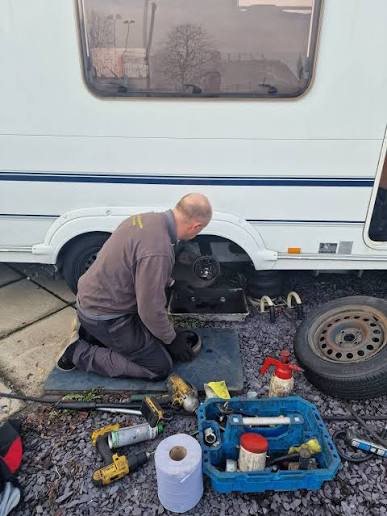
Caravan repair · Costa Blanca
Caravan Repair & Servicing on the Costa Blanca — We Come to You
Damp, electrics, brakes, bearings and running gear — serviced where your caravan is parked. No towing it across the coast to a workshop, no waiting for a slot, no leaving it weeks at a time.
Dénia · Jávea · Moraira · Calpe · Benissa · Altea · Albir · Benidorm · Villajoyosa and inland
- We come to you
site, storage, driveway - Damp first
the thing that kills caravans - Fixed quote
before we start - Invoice
factura from autonomo
Not a motorhome
A caravan is a different job from a motorhome — and it gets a different page for a reason
Caravans and motorhomes look similar on a campsite, but underneath they share almost nothing. A caravan has no engine, no alternator, no starter. What it has instead is a tow hitch, a chassis, running gear, brakes that work on overrun, and a body that lives outdoors year-round on the coast. It’s a completely different set of problems.
The biggest one is damp. Anyone who’s owned a British caravan on the Costa Blanca for more than a couple of seasons has either dealt with it or knows someone who has. It’s the single thing that turns a €6,000 caravan into a €2,000 caravan, and it’s also the single thing that’s easiest to catch early if you know where to look.
This page covers what we do on caravans at your pitch — damp inspection, running gear, brakes, electrics, water, and seasonal servicing. If you’re looking for motorhome work, that’s a different page →.
The one that matters most
Damp — the thing that quietly writes off caravans
If you take nothing else from this page, take this: damp is the difference between a caravan that keeps its value and one that becomes a project nobody wants. It doesn’t announce itself. There’s no smoke, no noise, no warning light. By the time you can see it or smell it, it’s usually been developing for months — sometimes longer.
Where it starts
The same places on almost every caravan, in almost every case:
- Around roof seams and skylights — sealant dries out in the Spanish sun faster than in the UK, and every crack is a path in
- Front and rear panels — where the body meets the corner trims. Classic entry point
- Around windows — especially the front window and any window that faces the sea
- Awning rail — water tracks along the rail and finds every screw hole
- Floor corners — usually from the inside, from condensation, or from a leak that’s been running down
How we check it
With a moisture meter, systematically, all the way around the caravan — not just where you can see or reach easily. Read at multiple depths and recorded, so we can tell the difference between «a bit high, worth watching» and «this needs attention now».
The reading isn’t the whole story. We look behind cushions, under seats, inside cupboards, up into corners. We check sealant condition everywhere. We check for the smell — because a damp caravan has a smell, and once you know it, you know it.
If something looks marginal, we say so and we don’t push it. If it’s a proper issue, we tell you where and how bad. If it’s dry, we tell you it’s dry — plenty of caravans are.
What we do about it
If the damp has just started — a leaking seal, a tired roof seam, a window that needs resealing — that’s a job we can do at your pitch. Clean the surface properly, remove old sealant, reapply, re-check.
If the damp has gone into the structure — soft wood, blackened framing, sagging ceiling — that’s a bigger job. It needs the panel open, the frame replaced, and it needs to be done inside. We tell you that straight, and we point you at the right workshop. We don’t take a job we can’t do properly at your pitch.
The mistake people make
Ignoring the early signs because «it doesn’t look that bad» and then finding out two years later that the whole rear frame has gone. Damp is a slow, compounding problem — the cost of fixing it in year one is a fraction of the cost in year three.
If you’re buying a used caravan, always get a damp check before you hand over money. It’s the single most valuable €80–€100 you’ll spend on the whole purchase. If a seller won’t allow it, walk away.
Running gear
Chassis, bearings, brakes and the tow hitch
This is the mechanical side of a caravan — the part that has to work on the motorway at 90 km/h, in heat, with a family inside. Serviced where it’s parked, checked properly.
Wheel bearings
Caravan bearings run hot and take a beating, especially on a long tow in summer. Repack or replace, check the seals, and clean up any sign of water ingress. A bearing that goes at motorway speed can destroy the stub axle and take the wheel with it. If you’ve done 10,000 km or more since the last check, it’s worth doing.
Brakes and overrun system
Caravan brakes work on overrun — the car pushes, the hitch compresses, the linkage applies the brakes. That linkage, the dampers and the brake shoes all wear. We strip, inspect, adjust, replace what needs replacing. This is also part of pre-travel prep for any long tow, and part of what an ITV inspector will look at on a Spanish-registered caravan.
Tow hitch and coupling
The coupling head, the stabiliser (if fitted), the handbrake, the breakaway cable — all checked and serviced. A worn stabiliser or a coupling that isn’t gripping properly is a handling problem at speed, and it’s the sort of thing that gets worse slowly until it doesn’t.
Chassis and underfloor
Visual inspection of the chassis rails, cross-members, mounting points and the A-frame. Check for corrosion, cracks, loose bolts. Coastal air and coastal damp accelerate corrosion — a caravan that lives outdoors here ages faster than one kept under cover.
Jockey wheel and corner steadies
Small things, but they’re the ones that fail when you’re setting up in the dark on a sloping pitch. Jockey wheel bearings, steady screws, the mounting brackets. Cheap to fix, annoying to have fail.
Tyres and pressures
We check tyres visually and tell you what we see — cracking, sidewall damage, uneven wear. Caravan tyres often age out before they wear out, and a five-year-old tyre with good tread is still a tyre that can fail on a hot motorway. Pressures matter more than most people think, especially loaded.
12V and 230V electrics
Electrics — the second-biggest source of problems on a caravan
Caravan electrics are simple in principle and complicated in practice, because you’re dealing with two completely separate systems that meet in one place. On the 230V side there’s the hookup, the socket circuits, the charger and (on newer caravans) the RCD. On the 12V side there’s the leisure battery, the lights, the pump, the fridge on 12V while towing, and the control panel that ties it all together.
When something stops working, the fault could be in either system, and often it’s a bad earth or a broken connector that crosses both. We trace faults methodically — not swap parts until something works. That’s a very different approach from a lot of «we’ll have a look» visits, and it’s what stops you replacing a charger that was never broken.
If you’ve just bought a caravan, one useful thing to do is have the electrics checked before your first trip, especially if the van has been sitting unused for a season. Batteries that have been flat all winter don’t always recover, and a charger that’s been trying to charge a dead battery for months may itself have failed.
The habitation side of caravans and the habitation side of motorhomes overlap a lot — same skills, same approach. More on that on our habitation service page →.
Water, fridge, windows, rooflights
The rest of the habitation side
Small jobs, mostly, but they’re the ones that turn a good trip into a frustrating one. Done at your pitch alongside the bigger work.
Water — pump, tanks, boiler, leaks
Fresh and waste tanks, pump, taps, shower, boiler. The most common issues: a pump that’s lost its prime, a microswitch in the tap that’s failed, a tank that’s started to leak at a fitting, a boiler that won’t light. Water leaks in a caravan are the second-leading cause of damp, right after roof seams — so if you find one, sort it quickly.
Fridge
Caravan fridges run on three sources: 230V on hookup, 12V while towing, and (on most) gas when off-grid. The most common British owner complaint is a fridge that works fine at home and badly on the coast in summer. Usually it’s one of two things — the 12V side getting insufficient power through the tow wiring, or the fridge struggling to shed heat in a caravan that’s been sitting in the sun all day.
Windows and rooflights
Seals dry out, catches fail, hinges break. A window that doesn’t seal is a leak path. A rooflight that won’t close properly is the same. We replace seals, catches and hinges, and reseal where needed. This is also one of the most common places for damp to get started — worth catching early.
Doors and locks
The main door, the storage locker doors, the lock barrels. Door seals that have compressed, hinges that have dropped, locks that are getting stiff. Small, cheap, and the sort of thing that just makes life easier.
Seasonal
Pre-storage and pre-travel checks
Two services nobody thinks to book, both of which save a lot of trouble later. The first is at the end of a season — before the caravan sits for months. The second is at the start, before you tow it somewhere.
Pre-storage: water drained, tanks emptied and cleaned, fridge defrosted and left open, battery disconnected or on a maintenance charger, damp check, and any small sealant jobs done while the weather is still dry. Cheaper and easier than fixing what four months of sitting still does to an unattended caravan.
Pre-travel: tyres and pressures, running gear, brakes, hitch, lights, tow wiring. This is the checklist that turns «we’ll just hitch up and go» into a trip that actually starts properly. If something’s marginal, better to know at the storage yard than on the N-332 with the family in the car.
If you’re towing the caravan back to the UK or to another part of Spain, a pre-travel check is worth doing two weeks before you go — that way if something needs a part, it arrives in time. Local parts next working day, anything from Germany or Poland typically three working days.
What we do ourselves, and what we pass on
We’d rather you knew this upfront than found out halfway through a job. Not everything on a caravan is something we do at your pitch — some jobs genuinely need a workshop, or a specialist. Here’s the honest split.
We do at your pitch
- Damp inspection with a meter, recorded readings
- Resealing — roof seams, windows, skylights, awning rail
- Running gear: bearings, brakes, overrun, hitch
- Chassis and underfloor visual inspection
- 12V and 230V electrics, fault tracing
- Leisure battery testing and replacement
- Water system — pump, tanks, taps, leaks
- Windows, rooflights, door seals and locks
- Seasonal pre-storage and pre-travel checks
We pass to a workshop or specialist
- Structural damp repair — soft framing, rotted timber, sagging panels. Needs the panel open and a workshop. We’ll tell you which workshop and help you organise it
- Heavy chassis welding or fabrication — bodyshop job
- Body panel and paintwork — dedicated bodyshop
- Tyre replacement itself — tyre shop. We inspect, we tell you what we see, we don’t do the swap
- Gas work on the caravan’s gas installation — needs a certified gas installer with the correct Spanish registration. Not us
- Full habitation rebuild after major damage — insurance-approved workshop, not mobile work
When a job isn’t ours, we say so before we take any money. We don’t turn up, spend two hours, and then tell you it needs a taller. That’s not how this works.
FAQ
Frequently asked questions
What caravan owners ask us before booking anything.
Do you come to the caravan, or do I bring it to you?
We come to you — campsite, storage yard, driveway, aire. Caravans rarely need to be moved for the work we do, and towing them to a workshop on the coast is a hassle nobody wants. If it’s a job that genuinely needs a workshop, we’ll tell you and help you organise that instead. But for the vast majority of what’s on this page, we work where it’s parked.
How do I know if my caravan has damp?
You don’t, without a meter — that’s the whole problem. Visual inspection tells you it’s very bad. Smell tells you it’s been bad for a while. A moisture meter tells you what’s actually happening, including the areas you can’t see. If the caravan has been outdoors on the coast for more than two or three seasons, or you’ve bought it second hand and don’t know its history, a damp check is worth doing at least once a year. It’s the single most useful thing anyone can tell you about a caravan.
Can you fix damp, or just tell me about it?
Both, depending on how far it’s gone. If it’s a leaking seam, a failing window seal or a tired rooflight — that’s what we do at the pitch, and it stops the damp getting worse. If it’s gone into the structure — soft wood, blackened framing, sagging ceiling — that needs the panel open and it needs a workshop. We’ll tell you clearly which one you’re looking at, and if it’s the second, we won’t waste your time or money taking the job ourselves.
My caravan is Spanish-registered — can you help with ITV prep?
Yes, in the parts that are mechanical and habitation-related. Running gear, brakes, lights, tyres, damp. The ITV inspector will look at those, and they’ll also want to see that the caravan is fundamentally sound. What we can’t do is sign anything off on ITV — that’s the inspector’s job, and for anything else ITV-related, a gestor is the right person to talk to. We just make sure the mechanical and habitation side is in good shape before it goes in.
How quickly can you come?
Same day where possible — Saturday 9:00–20:00, Sunday 10:00–18:00 for diagnostics and call-outs, weekday evenings until 21:00. Not same hour: it’s one van on the road, and if the call before yours is in Calpe and you’re in Jávea, you’ll wait a couple of hours rather than twenty minutes. For planned work — pre-travel, pre-storage, seasonal — we can usually book a day that suits you, which is better for everyone.
Do you give an invoice?
Yes, always. A proper factura from an autonomo, itemising the work and parts. Useful for records, useful if the caravan is on insurance, and useful if you’re selling it later — a documented service history is worth more than a verbal «yeah, it’s been looked after». If you need it made out to a company name, tell us when we confirm the job.
Caravan problem? Message us
📲 WhatsApp us
Caravan problem? Message us
Send the make, model and year, what’s happening, and where the caravan is parked. We’ll tell you if it’s a call-out, a job that can wait, or something that needs a workshop — before you commit to anything.