
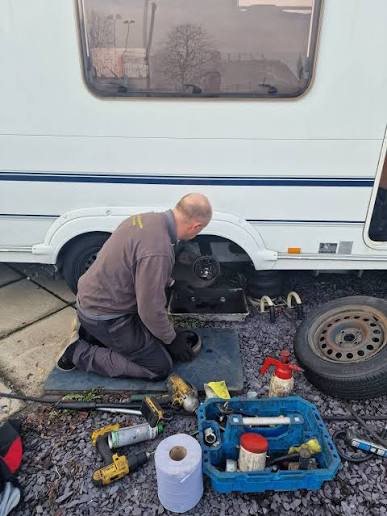
Motorhome breakdown · Spain
Motorhome Breakdown in Spain — What to Do, In Order
Six things that go wrong on the coast, what each one usually means, what you can check yourself without tools, and at what point it stops being a DIY job. No scare tactics — just what’s actually happening.
Dénia · Jávea · Moraira · Calpe · Benissa · Altea · Albir · Benidorm · Villajoyosa
- Six faults
that strand a motorhome - Check yourself first
no tools needed - What NOT to do
the expensive mistakes - When to call
and what to send us
How to use this page
Find your symptom. Read the honest answer.
Most motorhome problems that look like a breakdown aren’t one — they’re a starter, a battery, a wire, or a warning light that says «check me» and nothing more. Nine times out of ten, a mobile mechanic at your pitch fixes it in a couple of hours. The other one time, you genuinely need a workshop, and we’ll tell you that too.
Each section below follows the same order: what the symptom usually means → what you can check yourself for free → what not to do → when to call. We’re not going to tell you that everything is urgent. Some of it is; some of it isn’t.
Symptom 01
The motorhome won’t start
You turn the key (or press the button) and nothing happens, or you get a click, or it turns over slowly and never catches. Three very different problems, and which one you have decides the next step.
What it usually means
Nothing at all, no click: battery flat, main fuse blown, immobiliser engaged, ignition switch, or a starter relay.
One loud click, nothing else: classic sign of a starter solenoid that’s engaged but can’t spin the motor — usually the starter itself, sometimes a weak battery that can’t supply the current.
Turns over slowly, never fires: battery too weak, or fuel isn’t getting to the engine (diesel: glow plugs, lift pump, air in the fuel line).
Check yourself, free
- Headlights on, try to start — if they dim heavily, it’s the battery
- Try the horn — a weak horn with dim lights usually confirms a flat battery
- If it’s an automatic, is it definitely in Park?
- Is the immobiliser light on the dash behaving normally?
- Any recent work under the dash, or water ingress after rain? Check fuses.
Don’t do this
- Don’t keep cranking. You’ll flatten a battery that might have been jump-startable, and you can damage a starter that’s trying to engage
- Don’t jump-start from another vehicle unless you know the correct procedure for your base — wrong order of connection can kill the ECU. Modern motorhomes are not old Land Rovers
- Don’t pour «starter spray» into a diesel intake. It can cause serious internal damage on modern engines
When to call us
As soon as you’ve ruled out the battery and the obvious fuses. A starter motor on most motorhome bases can be replaced at your pitch without a lift — the diagnostic takes minutes, and the swap usually takes an hour and a half. We carry common bases’ starters or can source them next working day locally.
If you’re stuck somewhere unsafe — on a road, in a busy car park — say so in your message. We’ll prioritise accordingly.
Symptom 02
Leisure battery flat — won’t hold a charge
The living side of the van has no power. Lights dim, fridge doesn’t cool, USB sockets dead. The starter battery is fine and the engine runs. This is the habitation system, not the base vehicle — but there’s a lot you can check yourself before it becomes anyone’s call-out.
What it usually means
One battery, everything dead after a couple of days: the battery itself is dying, or it isn’t being charged while you drive.
Charges on hookup, drains on the road: split-charge relay fault — the van’s alternator isn’t feeding the leisure battery while driving.
Charges fine, dies overnight anyway: parasitic drain. Something in the habitation circuit is pulling current when it shouldn’t — a fridge on 12V, an inverter on standby, a USB charger plugged in, a faulty relay.
Check yourself, free
- Is the battery actually being charged on hookup? Check the panel voltage climbs to ~13.5–14.4 V
- Is the fridge accidentally switched to 12V while parked? Classic overnight drain
- Is the solar controller showing input? If it’s blank, it may have failed
- Any obvious loose terminal or corrosion? Wiggle test with the power off
- If the van has been sitting for weeks — was anything left on? The answer is usually yes
Don’t do this
- Don’t guess the battery is dead and buy a new one. If the fault is a split-charge relay or a parasitic drain, the new battery will die the same way in a week
- Don’t swap lead-acid for lithium without checking the charger and the split-charge system support it. It’s not plug-and-play, and getting it wrong can kill both batteries and the alternator
- Don’t run the engine at idle for hours to «charge the leisure battery». Motorhomes’ alternators often don’t feed the leisure side at idle, and you’ll just burn diesel
When to call us
If the battery is genuinely done — three or four years old, won’t hold a charge on the bench — replacement at your pitch takes about an hour. If the fault is the split-charge or the wiring, we diagnose it in the same visit. The habitation side is a different job from the base vehicle, and it’s covered in more depth on our habitation service page →.
Symptom 03
Warning light on the dash — can I keep driving?
Not all lights mean stop. Some mean «book it in this week», some mean «pull over now». The colour is the first signal — but only the first.
What it usually means
Green or blue: a system is on. Nothing wrong. Indicators, main beam, sometimes cruise control.
Yellow / amber: something to check — usually soon, not right now. Engine management, DPF, ABS, glow plugs, traction control, tyre pressure. You can normally continue to a safe place and a message.
Red: stop when safe. Oil pressure, coolant temperature, brake fault, battery charging. Red means the engine is potentially being damaged as you drive.
Check yourself, free
- Which light exactly? Note the symbol — not «the engine one», the exact shape
- Is it steady, or flashing? Flashing on engine management usually means «stop at the next safe place»
- Any other symptom with it? Rough idle, loss of power, smell, sound?
- Did it come on right after refuelling? Loose fuel cap is a real cause of engine light on many cars and some motorhome bases
- Has anything changed in the last hour — rain, big bump, long climb?
Don’t do this
- Don’t clear the code and hope. The light will come back. Clearing it deletes the freeze-frame data that tells a mechanic exactly when the fault happened
- Don’t ignore a flashing engine light and drive 200 km to your next campsite. On some faults, that writes off the catalytic converter or DPF — a €1,500+ mistake
- Don’t disconnect the battery to «reset» the light. On a motorhome that can wipe radio codes, ECU adaptions and, on some models, immobiliser pairing
When to call us
On any steady amber light, message us with the exact symbol, the vehicle model and what the van was doing when it came on. We read the codes on-site, explain what they mean in plain English, and tell you honestly whether it’s a «fix now», a «fix this week», or a «clear it and see if it returns». If it’s a red light — stop first, then message. Don’t drive on a red.
Symptom 04
Flat tyre, no spare, or the jack won’t take the weight
This is one where a motorhome is fundamentally different from a car. The standard scissor jack in most motorhome toolkits barely lifts 3.5 tonnes, and many don’t come with a spare at all. Here’s the honest picture.
What it usually means
Slow puncture: a nail or screw. You can often get to a tyre shop on the coast before it goes flat, if you spot it early.
Sudden blowout: this is a roadside emergency. Do not attempt a swap on a motorhome yourself unless you have proper equipment — see below.
Jack «works» but won’t lift: it’s a car jack. It’s rated for 1.5–2 tonnes. A 3.5-tonne motorhome is not that.
Check yourself, free
- Look at every tyre before you set off each morning. Bulges, cracking, foreign objects
- Check the jack in your toolkit. If it’s a scissor jack, note its rated capacity — that number matters
- Do you have a spare? Not all motorhomes do. If not, you’ll be relying on a tyre shop or a recovery service
- Do you have a tyre pressure gauge and do you know the correct pressures for your van? Not the numbers on the tyre sidewall — the numbers in your vehicle manual
Don’t do this
- Don’t jack a 3.5-tonne motorhome on a scissor jack. If it folds, the vehicle comes down. This has killed people
- Don’t change a wheel on a live road. Whatever you’re losing in time, the risk to your life is not worth it
- Don’t drive on a flat «just to the next junction». You’ll destroy the wheel and possibly the hub, and a wheel is much more expensive than a tyre
- Don’t use tyre sealant foam on a motorhome unless you’ve read what it does to your TPMS sensor and whether your tyre shop will accept the wheel
When to call — and who to call
Tyres are not our job — that’s a tyre shop or a roadside tyre service. What we do cover is the aftermath: if a tyre failure has damaged the hub, the wheel arch or the sensor wiring, we diagnose and fix that on your pitch. If you’re stuck and don’t know who to call, message us and we’ll point you at the right local number — even if it’s not a job for us.
Symptom 05
Overheating on a climb in the heat
Every summer, the same scene plays out on the climbs between Dénia and Altea, or up towards the Jalon valley. A motorhome, fully loaded, in 35°C heat, and the temperature gauge climbing. Here’s what’s actually happening and what to do.
What it usually means
Gauge climbs under load but drops on the descent: this can be normal on a hot day. A loaded 3.5-tonne motorhome climbing in 35°C puts a real thermal load on the cooling system. If it drops once you’re over the top, you’re probably fine.
Gauge climbs and stays high: something in the cooling system. Coolant low (small leak), thermostat sticking, radiator fan not kicking in, radiator blocked externally with dust and insects, or an internally clogged radiator.
Overheats within minutes of cold start: serious. Usually a failed water pump, or a head gasket. Stop and call.
Check yourself, free
- Coolant level in the header tank — engine cold. If it’s low, note how low
- Any dried coolant residue — pink or orange crust — around hoses, the radiator or the head?
- Is the radiator fan running when the engine is hot and the van is standing still?
- Shine a torch through the radiator grille. Is it blocked with dust, insects, plant material?
- Are you driving differently here than at home? A loaded van on a 6% climb in August is not the same as the M25
Don’t do this
- Don’t open the coolant cap while the engine is hot. Pressurised boiling coolant will scald you
- Don’t pour cold water into an overheated engine. Thermal shock can crack a head or a block
- Don’t keep driving with the needle in the red. A €200 head gasket job becomes a €2,000 engine job fast
- Don’t top up with plain water and forget. If you had to add more than half a litre, something’s wrong. Top up coolant if you can, water if you can’t — and get it checked
When to call us
If the needle has been in the red even once, or if you’ve had to top up coolant more than once in a trip — message us. If it’s a fan, a thermostat, a hose or a sensor, most of that can be diagnosed at the pitch. If it’s a water pump or head gasket, we’ll tell you it needs a workshop and help organise it. Don’t let it «just fix itself on the next drive». It won’t.
Symptom 06
Diesel has no power — limp mode
You’re driving normally and suddenly the van won’t rev past 2,000–2,500 rpm. The engine light is on. There’s no noise, no smoke, no obvious drama. It just feels like someone pulled the handbrake. That’s limp mode — the engine computer has detected a fault and locked the performance down to protect itself.
What it usually means
On the DPF: the particulate filter is loading up and the van’s regeneration cycle hasn’t completed. Very common on motorhomes that spend their lives on short trips between campsites.
On fuel delivery: low rail pressure, a failing injector, air in the fuel line, or a pump issue.
On turbo / EGR: turbo actuator fault, sticking EGR valve, boost leak from a split hose.
On sensors: MAF, MAP, or a temperature sensor sending bad data. Cheapest to fix, most common.
Check yourself, free
- Note the exact moment it happened — accelerating, cruising, after a stop?
- Did it come on right after refuelling? Fuel quality matters more on modern diesels than people think
- Is there any smoke? Black smoke = too much fuel / not enough air. White smoke = unburnt fuel. Either way, tell us
- Does the engine idle roughly, or just limit power? Different faults
- Has the engine been restarted since? Some limp modes clear on restart and stay cleared. Some don’t
Don’t do this
- Don’t keep driving in limp mode for hundreds of kilometres. The ECU entered limp mode to protect a component. Driving anyway often makes that component fail completely
- Don’t clear the code and drive on. If the underlying fault is still there, limp mode comes back — usually at a worse moment
- Don’t add «DPF cleaner» additives and hope. They help some light soot loading, they do nothing for mechanical failures, and some products can worsen injector problems
- Don’t ignore it and take the van on a long motorway trip. Limp mode on a hot climb with traffic behind you is not where you want to be
When to call us
As soon as limp mode appears and stays. We read the codes on-site, explain what they mean, and tell you honestly what the next step is. Most DPF-triggered limp modes can be resolved by a proper forced regeneration cycle — done on-site. Fuel and sensor faults can usually be diagnosed and often fixed at the pitch. If it turns out to be a serious mechanical fault, we say so and help you organise the workshop. More on diesel diagnostics →
Before you message
Send us the right information and we answer in minutes, not hours
When something’s gone wrong, the last thing you want is a back-and-forth over WhatsApp to work out what’s happening. Here’s what actually helps us tell you whether it’s a call-out, a workshop, or a «you can drive it home».
The vehicle
Make, model, year, and the base if you know it — Ducato, Boxer, Transit, Sprinter, Iveco. A photo of the registration document or the VIN plate is even better.
The symptom
What exactly happens when it happens. «Won’t start» is not enough — «one click, then nothing, headlights work fine» is. The detail is what tells us what it is.
The location
Where the vehicle is right now. Campsite name and pitch, aire, storage, or «on the shoulder of the N-332 just past Calpe». The more specific, the faster we can tell you when we can get there.
Photos and video
A short video of the dash when you turn the key, or a photo of the warning light, is often worth more than a paragraph. Anything under 20 seconds, no need to edit.
FAQ
Frequently asked questions
The ones we get when something has just gone wrong and the owner is trying to work out how bad it is.
Can you diagnose remotely before you come out?
To a point, yes. Send us the vehicle, the exact symptom, a video of what happens when you turn the key or start it, and a photo of the warning light if there is one. From that we can often tell you what it’s likely to be and whether we can fix it at the pitch. What we can’t do is confirm anything for certain without reading the actual codes and looking at the vehicle — so we’ll never quote a fix from a description alone.
Is it OK to drive with a warning light on?
Depends on the colour and whether it’s flashing. Amber steady = usually fine to drive to a safe place and message us. Amber flashing = stop at the next safe place, then message. Red = stop when safe, don’t drive further. If you’re unsure which it is, take a photo of the dash and send it — we’ll tell you straight away. There’s no charge for answering that question.
What if you can’t fix it at the pitch?
Then we tell you that before you commit to anything, and we tell you what kind of workshop you actually need — a general taller with a motorhome bay, a bodyshop, a diesel specialist, a tyre shop. We help coordinate the next step so you’re not left ringing six numbers and repeating the same story. The honesty about that boundary is the whole point — you get a straight answer, not a call-out fee that ends in «sorry, needs a taller».
How fast can you get to me?
Same day where possible — evenings and weekends included. Saturday 9:00–20:00, Sunday 10:00–18:00, weekday evenings until 21:00. Same day, not same hour: it’s one van on the road, and if the call before yours is someone in Altea and you’re in Jávea, you’ll wait a couple of hours rather than twenty minutes. What we do promise is a realistic arrival window before we set off, and we keep it.
Do you work on the habitation side too?
Yes, but it’s a different job — leisure batteries, solar, water, fridges, damp checks, air conditioning. That’s our habitation service, done by our team. For base-vehicle faults — engine, starter, alternator, wiring, limp mode — that’s what this page is about. If you’re not sure which side your problem is on, message us with what’s happening and we’ll tell you.
Do you give an invoice?
Yes, always. A proper factura from an autonomo, itemising the work and parts. Useful for records, useful for insurance — especially if the fault happened on holiday and you’re claiming through a UK policy — and useful when you sell the vehicle. If you need it made out to a company name, tell us when we confirm the job.
Something’s wrong with the van right now?
📲 WhatsApp us
Something wrong with the van? Message us
Send the make, model, base vehicle and what’s happening. A photo or a short video helps. We’ll tell you whether it’s a call-out, whether it can wait, or whether you need a workshop — before you commit to anything.