
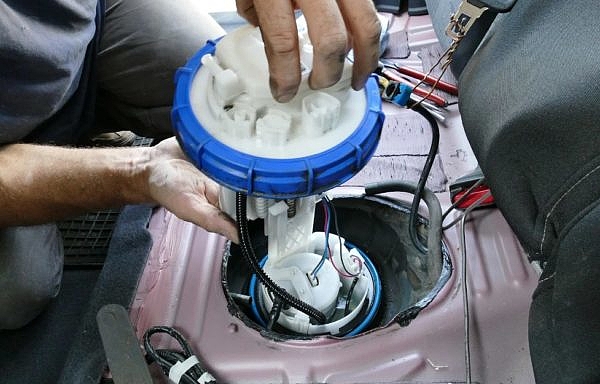
Diesel pumps · Costa Blanca
Diesel Fuel Pump Problems — Diagnosed Before They’re Replaced
Low rail pressure, cranking without starting, sudden loss of power? We find out whether it really is the pump before you pay for one.
Altea · Benidorm · Calpe · Albir · La Nucía · Finestrat · Moraira · Jávea · Denia
- Measured, not guessed
rail pressure vs commanded - Injectors ruled out first
return-flow before removal - Debris check
metal shavings, before fitting - Invoice
factura from autonomo
Before anyone quotes you for a pump
«Low rail pressure» is one of the easiest codes to misread
A high-pressure diesel pump is one of the most expensive parts on the car. And the code that usually triggers a pump replacement — low rail pressure — has at least five other possible causes that all produce the same complaint. A leaking injector, a clogged fuel filter, a worn low-pressure pump in the tank, a faulty pressure regulator, a bad sensor.
We separate them before anyone quotes you for a pump. That’s the whole point of the diagnostic visit. By the time we talk about the pump, it’s because the measurements say it’s the pump — not because the scanner printed a code.
If the pump is fine and the problem was upstream, you pay for a diagnostic and that’s it. We don’t fit a pump to close out a code.
First thing to get right
Two different pumps, two different jobs
«The pump» is not one thing on a diesel car. There are two, they do different work, and they fail differently.
Low-pressure pump (in the tank)
Also called the lift pump or in-tank pump. Its job is to move diesel from the tank to the engine bay at low pressure. When it fails, you get starvation — the engine cranks, sometimes fires, then dies. On a lot of diesels, a failing lift pump is the real reason the high-pressure side can’t build rail pressure. We check it before blaming anything else.
High-pressure pump (engine bay)
CP1, CP3, CP4 on Bosch systems, plus Delphi and Siemens variants. This one takes diesel from the low-pressure side and pushes it into the rail at hundreds of bar. When it fails, you get low rail pressure, sudden power loss and cranking without firing. It’s expensive — and it’s the one that has to be genuinely dead before we replace it.
Most «it’s the pump» diagnoses get the two confused. A lift pump costs a fraction of a high-pressure pump. On the cars we see, it’s worth spending an hour confirming which one is the problem before quoting for the expensive side.
What you notice
Symptoms of a failing pump
Pump symptoms overlap with injector symptoms. That’s exactly why the test order matters.
Cranks and cranks but won’t fire
The engine turns over normally — it just doesn’t start. No spark issue here, it’s a diesel. Fuel isn’t reaching the cylinders at pressure.
Starts, runs a few seconds, dies
Fires up briefly, then stops. Classic low-pressure starvation — the in-tank pump isn’t keeping up.
Sudden loss of power at motorway speed
You’re cruising, then power drops and limp mode comes on. High-pressure side can’t hold rail pressure under load.
Limp mode under load
The car drives normally until you ask it for power — a hill, an overtake — then backs off. Common rail pressure collapse under demand.
Whine or groan from the tank area
A noise you hear when you turn the key, sometimes continuously with the engine running. Usually the in-tank pump on its way out.
Low rail pressure codes
P0087, P0088, P0191, P1093 depending on manufacturer. The code says what the ECU has seen — not what the cause is.
Metal particles in the fuel filter
This is a diagnosis almost on its own. Fine metal shavings in the diesel mean the high-pressure pump is coming apart internally — and debris is already circulating through the whole fuel system. Do not just replace the pump. Read the next block.
Hard starting when cold, worse over weeks
Gradual rather than sudden. Can be either pump, or the injectors. Needs the test to separate them.
If the pump has been damaged and metal is already in the fuel, continuing to drive sends that debris into the injectors and the rail. Every kilometre after that point makes the eventual repair more expensive.
The diagnosis
How we tell the pump from everything else
Six measurements. Every one of them has to point at the pump before we talk about replacing it.
Actual vs commanded rail pressure
Live data shows what the ECU is asking for, and what the sensor is actually reading. A big gap at idle and under load tells us the high-pressure side isn’t delivering — but doesn’t yet say why.
Rail pressure at cold start
The hardest moment for the system. A pump that’s marginal will fail to build pressure on the first crank — when the engine is cold and there’s no heat to help combustion. This is often what «hard starting when cold» really is.
Injector return-flow test
Before the pump gets blamed, the injectors get ruled out. If one is returning too much fuel, the rail can’t hold pressure — and the pump is innocent. This step is what stops people replacing pumps that were never the problem.
Low-pressure circuit check
We measure pressure on the supply side — tank to engine bay. If the in-tank pump isn’t delivering, the high-pressure pump starves and can’t do its job. Cheapest fix on the list, and the easiest to miss.
Filter and fuel condition
A clogged filter strangles the whole system. A filter with metal particles tells a different story — that’s the pump coming apart. Both are read at the same time.
Pressure regulator check
The regulator controls how much pressure bleeds off the rail. If it’s stuck open, pressure drops even though the pump is fine. It’s the last thing to rule out before condemning the pump itself.
A pump is condemned by measurement, not by a code. If the readings say the pump is fine, we say so — and you keep your money.
Wrong fuel in a diesel — do not start the engine
Petrol in a diesel tank happens here more than you’d think — hire cars, borrowed cars, a moment of inattention at the pump. The rule is simple: if you realise before you start the engine, you have a chance to save it.
Do not turn the key. Do not prime the system. Do not try to «dilute it with diesel and hope». Petrol destroys the lubrication the high-pressure pump depends on, and once it’s circulating, the damage is instant and expensive.
Message us with your location. In most cases the correct answer is to drain and flush the system before anything is started. If you’ve already started the engine, we’ll tell you what to expect and where you stand.
This is one of the most common call-outs on the coast, and one of the few where acting in the first ten minutes actually changes the outcome.
Related
The other half of the diagnosis
The pump and the injectors are one diagnostic unit. If you’ve read this page, the injectors page is worth two minutes.
Diesel injectors
Return-flow test, bench report, refit and coding. The test that has to come before any pump replacement.
Diesel mechanic
Full diesel chain diagnosis: DPF, injectors, pump, rail pressure, glow plugs. Explained in English.
Debris from a failed pump or leaking injectors damages the DPF over time. If your filter has been giving trouble, the connection is worth understanding — our plain-English guide to car trouble in Spain covers the basics.
More services in English
Other English-speaking services on the Costa Blanca
All our services explained in English. Same coverage area, same way of working.
Auto electrician
Car won’t start, flat battery, alternator, starter. Diagnostic scanner on the spot.
Weekend mechanic
Saturday, Sunday and weekday evenings. Diagnosis and call-outs out of hours.
Diesel injectors
Rough idle, hard cold starts, misfire codes. Tested before anything is replaced.
Diesel pump
Low rail pressure, cranking without starting. Pumps diagnosed, not guessed.
Mobile mechanic
Breakdowns, electrical faults and diagnosis. We come to your car.
Diesel mechanic
DPF, injectors, pump, rail pressure, glow plugs. Full diesel chain diagnosis.
Convertible roof repair
Hydraulics, sensors, electronics. Workshop in Altea.
Car trouble in Spain
Practical guide for English speakers: warning lights, Spanish garage vocabulary, what to do first.
FAQ
Frequently asked questions
The ones we get before a pump diagnosis.
Is it the pump or the injectors?
From the symptoms alone, you can’t tell. Both produce low rail pressure, hard starting and loss of power. The only way to separate them is to measure: return-flow test for the injectors, live rail pressure and pressure regulator check for the pump. Sometimes it’s the low-pressure side, not the high-pressure pump at all — a much cheaper fix. The diagnostic order is: rule out the injectors, then rule out the low-pressure circuit, then look at the high-pressure pump.
Can you do this at the roadside?
The diagnosis, yes — that’s done wherever the car is. Pump replacement is a workshop job on most models, or a service call-out with the right tooling. Either way, the first thing is the diagnosis — nobody can tell you what the pump needs until the measurements are done, and the measurements don’t need a lift.
I put petrol in my diesel, what now?
Do not start the engine. Do not turn the key. Do not try to dilute it with more diesel. Petrol strips the lubrication from the pump and injectors the moment the system primes. Send us your location and we’ll come out — the correct fix is to drain and flush the fuel system before anything runs. If you’ve already started it, tell us straight away and we’ll tell you what to expect.
How much is a pump?
Depends on the system, and we tell you after measuring — not before. A high-pressure pump is one of the most expensive parts on a diesel car, which is exactly why we don’t quote for one until the diagnostics rule out everything else. If the pump has failed and it’s shed debris, the repair will include filter and often injectors too — you’ll hear that from us before the work starts, not after a second breakdown. What we can say now: the diagnostic visit is a fixed price, confirmed in WhatsApp before we set off.
Can I keep driving with low rail pressure?
If the car is still driving but in limp mode, you’re on borrowed time. Low rail pressure on a diesel often progresses — limp mode becomes «won’t start», and the debris risk from a failing pump grows every kilometre. If the car is with you and safe where it is, message us and we come out. If you’re on a motorway or in an unsafe position, the priorities are different — but the message is the same: don’t push it. Send the location.
Low rail pressure? Let’s measure before anyone quotes.
📲 WhatsApp us
Low rail pressure? Measure before you pay
Send the make, model and symptoms, plus your location. We come out, run the diagnostics, and tell you straight whether it’s the pump or something cheaper.