
Habitation service · Costa Blanca
Motorhome Habitation Service on the Costa Blanca
Leisure batteries, solar, 12V and 230V faults, water systems, fridges and damp checks — at your pitch, by people who do this all year on the coast.
Dénia · Jávea · Moraira · Calpe · Benissa · Altea · Albir · La Nucía · Finestrat · Benidorm · Villajoyosa
- Habitation specialists
12V, solar, water, damp - At your pitch
campsite, aire, storage - English spoken
no translation gaps - Invoice
factura from autonomo
The other half of the vehicle
Your base vehicle works. It’s everything behind the cab that’s failing
Most workshops only look at the engine and the chassis. The habitation side — the 12V system, the leisure battery, the solar, the water, the fridge, the damp — is a completely different set of skills, and most talleres don’t touch it.
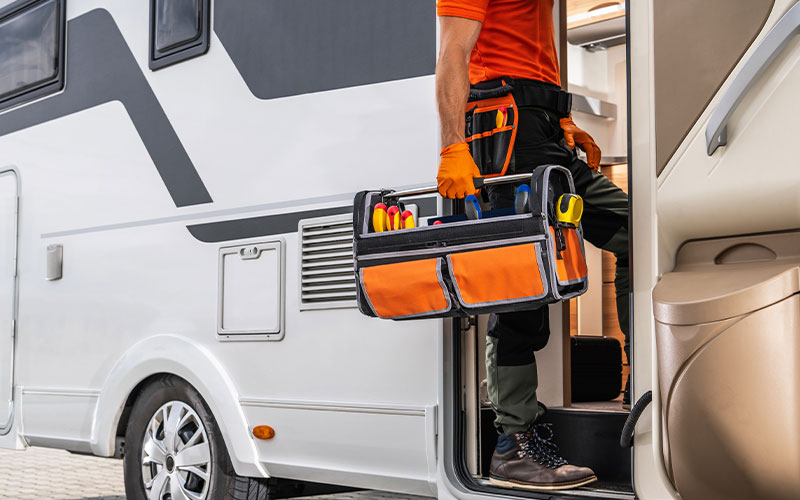
That’s the side we cover. Our team handles the electrics, the plumbing, the air conditioning and the damp checks. We come to your pitch, so you don’t have to unhook, drive anywhere, or leave the vehicle standing in a queue. If your problem is on the engine side instead — starting, charging, diesel, diagnostics — that’s the motorhome mechanic page →.
If you’ve got a habitation issue that keeps coming back — the leisure battery that won’t hold charge, the fridge that won’t cool on hookup, the damp patch that reappears after rain — those are the calls we get most often on the coast.
12V and leisure batteries
The single most common habitation problem
Most of the calls we get about the habitation side start with the leisure battery — not holding charge, going flat overnight, or not lasting through the evening.
Starter vs leisure — what’s the difference
The starter battery starts the engine. The leisure battery runs everything in the back — lights, fridge, water pump, USB chargers, inverter. They’re separate systems, and they fail for different reasons. If the cab battery is fine but everything in the back dies overnight, that’s the leisure side.
Lead-acid vs lithium
Lead-acid is what most motorhomes ship with. It’s cheap and it works, but it doesn’t like being run below 50% and it loses capacity over time. Lithium costs more up front, but gives you more usable capacity and lasts several times longer. We work on both — and we tell you honestly which one makes sense for how you use the vehicle.
Charging — split charge and chargers
The leisure battery needs to charge while you drive. That’s what a split charge relay or a DC-DC charger does. When it fails, you drive all day and the leisure battery still goes flat. We test the whole circuit: split charge, onboard charger, and — if you’re on hook-up — the 230V charger side.
Parasitic drain — something’s eating power
The leisure battery is full when you go to bed. By morning, it’s dead. Something is drawing power with everything switched off. Common culprits: the fridge on 12V, a faulty inverter, a stuck relay, or a TV/satellite box left on standby. We trace the drain by measuring the current at the battery with everything off.
Solar
Why your panel doesn’t give what you were promised
A 200W panel doesn’t give 200W. On a good day in southern Spain, flat-mounted and clean, you’ll see maybe 70–80% of the rated output for a few hours either side of noon. That’s not a fault — that’s how solar works. But it’s also not what people are told when they buy a kit.
What we do: install panels properly, size the controller to the array, check that the cable gauge is adequate for the run from roof to controller, and — most importantly — tell you what the real-world output will be before you buy anything.
If your existing panel is underperforming, the usual causes are: shading from the aerial or roof vent, a PWM controller where you need MPPT, dirty panels, or a cable that’s too thin for the length of the run.
230V and hook-up
What we check on the mains side
Most habitation faults on the 230V side are simple. But they’re also the ones that trip the campsite breaker at 2am, which nobody enjoys.
The hook-up cable and connector
The blue 16A cable and connector take a beating — driven over, left in the rain, plugged and unplugged hundreds of times. A worn connector causes voltage drop and heat. We check continuity, condition, and whether the cable is actually rated for the load you’re pulling.
RCD and circuit breakers
The RCD (earth leakage breaker) protects you from electric shock. It should be tested periodically — pressing the test button and confirming it trips. If it doesn’t trip, it needs replacing. This isn’t optional. Same for the circuit breakers on each circuit.
Socket outlets and internal wiring
Loose sockets, damaged cable, dodgy extension leads inside the vehicle. We check the internal 230V circuits and look for anything that’s running hot or has been bodged by a previous owner.
Charger and 12V supply on hook-up
When you’re on 230V, the onboard charger should be keeping the leisure battery topped up. If it isn’t, the battery goes flat even though you’re plugged in. We test the charger output and the 12V supply while you’re on hook-up.
Water
Pumps, tanks, leaks and the boiler
The water system is simple until it isn’t. A pump that runs continuously means a leak somewhere, or a pressure switch that’s failed. A pump that doesn’t run at all is usually the fuse, the switch, or the pump itself. Water in the wrong place — under the floor, behind a panel, in a locker — is what turns into damp later.
We check the pump, the pressure switch, the tank, the boiler, and we look for the leaks that are easy to miss: the ones that only appear when the system is pressurised, or only when the boiler is hot.
If the vehicle is being laid up for winter, we can drain the system properly. If it’s coming out of winter storage, we check everything before you refill and pressurise.
Fridge
The most common complaint from British owners
«The fridge works on hook-up but not while I’m driving.» Or: «It runs but it never gets properly cold.» Or: «It stopped cooling altogether.»
Two modes we work on
A motorhome fridge runs on 230V when you’re on hook-up, and 12V while you’re driving. Each mode has its own components — and when one mode fails, it’s usually specific to that mode, not the whole fridge. That’s good news: it’s almost always cheaper to fix than to replace.
Won’t work on 12V
The 12V element draws a lot of current — typically 10–15 amps. If the wiring is too thin, the voltage drops and the element doesn’t get hot enough. If the relay that switches 12V to the fridge has failed, the fridge never sees power. We check both.
Won’t work on 230V
Usually the heating element has failed, or the thermostat is faulty. Less common than 12V faults, but it happens — especially on older fridges where the element has simply reached end of life.
Runs but doesn’t cool well
On the coast in summer, an absorption fridge is being asked to hold temperature in 35°C+ heat. If the vents are blocked, if the van is parked broadside to the sun, or if the fridge is on the sunny side, it can’t shed heat fast enough. We check ventilation, airflow, and the cooling unit itself.
We don’t replace fridges unless we have to. Most fridge faults are fixable for a fraction of the cost of a new unit.
Damp — the word every British owner already knows
If you’ve owned a caravan or motorhome in the UK, you know what damp does. It starts small — a soft patch in a corner, a stain on the wallboard, a musty smell in a locker — and it spreads. By the time it’s obvious, it’s usually a serious repair.
The Spanish climate helps. But it doesn’t stop damp. Water still gets in through the same places: roof seams, window seals, locker doors, the joint between the cab and the habitation box, and around any fitting that’s been screwed into the wall from outside.
- We check with a moisture meter — around the known leak points, plus the areas that are hardest to see: under the seats, inside lockers, behind the fridge, around the shower tray.
- We tell you what we find — a reading, not a guess. If a patch is dry, it’s dry. If it’s reading high, you get the number and the location.
- We tell you what needs doing — resealing a window is a different job to repairing a rotted frame. We say which one it is.
Catching damp early is the difference between a €100 reseal and a €2,000 repair. If you’re buying a used motorhome, a damp check is one of the first things to book.
Air conditioning
Service and repair
On the coast, the roof aircon gets used hard for six months of the year. It needs servicing like anything else.
Not cooling properly
Either the refrigerant has leaked, the condenser is blocked with dust and debris, or the compressor isn’t running. We check pressure, clean the condenser and test the electrical side.
Leaking water inside
The condensate drain is blocked. It’s a simple fix, but it makes a mess if you leave it. We clear the drain and check the tray.
Making noise or not starting
Roof aircon units are exposed to everything. Fan bearings wear, capacitors fail, control boards get damp. We diagnose before replacing — often it’s a component, not the whole unit.
Regular servicing
Cleaning the filters, the condenser and the drain twice a year keeps the unit working efficiently and extends its life. It also stops that musty smell that develops when a unit sits with a dirty filter through winter.
How it works
Message us, we come out, we fix it at your pitch
The same way we handle the mechanical side — same team, same area, same approach. Habitation work is usually planned, not urgent, so we can normally find a day that suits you.
Message us on WhatsApp
Tell us the make, model, year and what’s not working. Photos help — especially of anything that’s visibly damaged or leaking.
We confirm the day and time
We come to your pitch, your campsite or your storage yard. We give you a specific day and a time window before you commit to anything — no optimistic «same day» promises that we can’t keep.
We diagnose on site
Test, measure, trace the fault. You get told what’s actually wrong — not just what needs replacing.
Fixed quote before we start
With the fault confirmed, you get a written quote. If it’s a simple fix, we do it there and then. If it needs a part, we tell you the lead time.
Lead times on habitation parts: most common components are local and arrive next day. Specific items — some fridge components, certain solar controllers — come from Germany or Poland, around three days. We tell you which before you commit.
Other motorhome services
If this isn’t what you need, one of these might be
Same team, same area, different side of the vehicle.
Motorhome mechanic
Starting, charging, diesel, electrics and servicing — the mechanical side, at your pitch.
Oil and filter change
Oil to your engine’s exact specification, old oil taken away and disposed of legally.
Caravan repair
Damp, electrics, chassis, brakes and running gear — for caravans, not motorhomes.
FAQ
Frequently asked questions
What owners ask us about the habitation side.
Who actually does the work?
Our team. Electricians, plumbers, air conditioning specialists and general habitation hands — the same people who’ve been doing this on the coast for years. You message us, we organise the visit, and the invoice comes through us. One point of contact, one invoice, one team.
How quickly can you come out?
We don’t promise same-day for habitation work — it’s usually planned, not urgent, and we’d rather give you a real day than an optimistic one. What we do promise: when you message, we’ll tell you a specific day and time window before you commit to anything. Most habitation jobs get booked within a few days, sometimes sooner in quiet periods. If it’s urgent, say so in your message — we’ll tell you honestly what we can do.
Do you cover all of the habitation side?
The main systems, yes: 12V and leisure batteries, solar, 230V and hook-up, water, fridges, damp checks and air conditioning. If it’s something outside that — a very specific appliance brand we can’t get parts for, or structural work — we’ll tell you honestly and point you to someone who can help.
Can you come to a campsite?
Yes, as long as the site allows it. Some sites want advance notice that a contractor is coming. Tell us which site you’re on when you message, and we’ll sort it out.
My leisure battery goes flat overnight — can you find out why?
Yes, and it’s one of the most common things we get called for. There’s a current being drawn somewhere with everything switched off. We measure the draw at the battery, then work through the circuits to find what’s causing it. Sometimes it’s obvious — a fridge left on 12V, a faulty inverter. Sometimes it takes longer. Either way, we find it.
Can you check for damp before I buy a used motorhome?
Yes. A damp check is one of the most useful things to do before buying. We come to wherever the vehicle is, check the known leak points with a moisture meter, and give you a written report with the readings. If there’s a problem, you’ll know before you hand over money.
Do you give an invoice?
Yes, always. A proper factura from an autonomo, itemising the work and parts. Useful for records, insurance, and when you sell the vehicle later.
Habitation problem? Message us
📲 WhatsApp us
Habitation problem? Message us
Send the make, model and what’s not working, plus your pitch or location. We’ll tell you when we can come out and what to expect — before you commit to anything.