
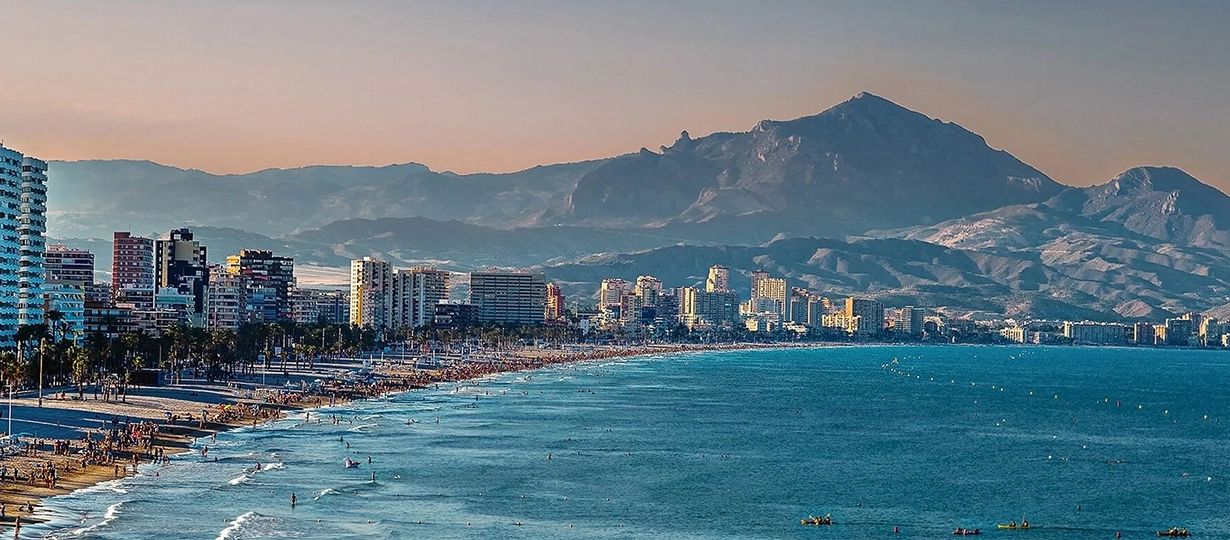
Motorhome mechanic · Benidorm · Trusted by British owners on the coast
Mobile Motorhome Mechanic in Benidorm — Engine, Electrics, Diagnostics
Your van is 3.5 tonnes, 7 metres long, and it’s where you live. Most talleres here won’t take it — not because the job is hard, but because the ramp won’t fit. We come to your pitch, your campsite or your storage, and most jobs get finished there.
Benidorm · La Nucía · Finestrat · Alfaz del Pi · Albir · Altea · Villajoyosa
- We take 3.5t motorhomes
most talleres here don’t - Benidorm campsites
we come to your pitch - Fixed quote
before we start - Invoice
factura from autonomo
Why Benidorm is different
Benidorm isn’t a summer town — it’s a motorhome town, all year round
Most of the Costa Blanca changes with the seasons. Benidorm doesn’t. In winter it fills up with British, Dutch and German motorhomers who stay for weeks or months — parked on the campsites, in storage, in the urbanizaciones around La Nucía, Finestrat and Alfaz. In summer the tourists come, the town gets busy, and the same vans are still here — just with different problems.
What that means in practice: most talleres here don’t want to work on a 3.5-tonne motorhome. A two-post ramp is built for a car. A motorhome is 6–7 metres long, close to 3 metres tall, and 3.5 tonnes on the scales — heavier than the ramp was designed for. So either they turn you away, or they put you in a queue for the one bay that can take it. Winter or summer, that queue doesn’t move fast.
We work the other way round. We come to your pitch, your campsite or your storage, and most jobs get finished where the vehicle is parked — starting, charging, diesel, electrics, diagnostics, oil and filters. Nine jobs in ten don’t need a lift in the first place — they need someone who’ll actually show up.
One more thing worth knowing: in winter, local parts suppliers work Monday to Saturday. If your starter dies on a Tuesday in January, we can often have the part and fit it the same day. In July, if it dies on a Saturday, you’re waiting until Monday. That’s the one upside of winter breakdowns here.
Winter breakdowns
What goes wrong on a motorhome that sits all winter
A van that’s lived in, not driven, wears in different ways. These are the things we see most often between November and March.
Battery — starter and leisure
Short trips around town don’t charge a battery properly. A starter battery that’s been asked to start a cold engine every day, on 15-minute drives, quietly loses capacity. By February it won’t turn the engine over. Same for the leisure side — if you’re not driving enough to charge it, and the solar isn’t keeping up, it goes flat and stays flat.
Starter motor
The starter does more work when it’s cold. It’s the highest-current component on the vehicle, and it’s the one that gives up first when the battery is borderline. Classic pattern: the battery is weak, you keep cranking, and you kill the starter trying to start the engine. Two jobs instead of one.
DPF from short trips
Diesel particulate filters need a long run at speed to regenerate — burn off the soot that accumulates in normal driving. A motorhome that goes to the supermarket and back, three times a week, never gets hot enough. The DPF loads up, limp mode kicks in, and you’re stranded with a filter that needs a forced regen — or replacement.
Wiring and connectors
Coastal air is salty, and winter humidity is high. Connectors corrode, earth points build resistance, and intermittent faults appear that only show up on wet mornings. These are the hardest faults to find — because they only happen sometimes. Tracing them properly takes a meter and patience, not swapping parts.
Split charge and charging system
The split-charge relay or DC-DC charger that feeds the leisure battery from the alternator — it works less in winter, because you’re driving less. When it fails quietly, you don’t notice until the leisure battery is dead and the fridge has been off for a day. By then the battery may be unrecoverable.
Water system and damp
If you’re living in the van, you’re using the water system every day — but the tank sits at ambient temperature, and the boiler works harder. Leaks at fittings get worse, pumps fail, and a small drip under the shower tray quietly feeds damp into the floor structure. Worth checking before the wet season, not after.
None of this is design failure. It’s just what happens when a vehicle that was built for mixed use is used as a home, in one place, for months at a time. The trick is to check things on schedule rather than waiting for them to fail.
Where we come to
Benidorm campsites, storage and pitches
These are the sites and areas we work on most often in and around Benidorm. If your van is elsewhere — a different campsite, a storage yard, a residential street — message us anyway. If it’s legal and safe to work there, we’ll come.
Benidorm — main sites
Camping Villasol · Camping El Racó · Camping Benisol · Camping Arena Blanca · Camping La Torreta · Camping Armanello · Almafrá Gran Confort
Around Benidorm
Camping La Media Legua (Albir) · Camperlive Benidorm · Orange Grove Camper Park · Paraíso Camper · areas around La Nucía, Finestrat, Alfaz del Pi
Storage and private
Private storage yards · urbanizaciones · residential driveways. If access needs a code, a name at the gate or a pitch number, tell us in the message.
Outside the main area
Altea · Albir · Villajoyosa · Polop · Callosa d’en Sarrià. We cover the wider Marina Baixa — if you’re further out, ask.
One important thing about Benidorm: overnight parking outside a campsite is restricted. The town has specific rules about motorhomes — you can park for up to 48 hours, but you cannot extend anything outside the vehicle (chairs, awnings, tables). If you’re parked on the street or a public car park, tell us — the work itself is normally fine, but we’ll confirm before we set off.
Two systems, one van
Base vehicle and habitation — we work on both
A motorhome is two machines in one. The base vehicle — engine, starter, alternator, diesel, wiring, diagnostics — is a commercial van. The habitation side — 12V, solar, water, fridges, damp, aircon — is everything that makes it a home. Most workshops here only handle one. We handle both.
Base vehicle — what we do
- Won’t start — battery, starter, immobiliser, ignition, fuel
- Starter motor replacement — at the pitch on most bases
- Alternator and charging faults
- Split charge and voltage drop
- Wiring and electrical faults
- Fault code reading and diagnostics
- Diesel — injectors, pump, glow plugs, rail pressure
- Overheating — radiator, thermostat, coolant leaks
- Brakes, suspension and oil change — without a lift
Habitation — what we do
- Leisure batteries — testing, replacement, lithium upgrades
- Solar — install, diagnose, controller upgrades
- 230V and campsite hookup — RCD, sockets, charger
- Water systems — pump, tanks, leaks, boiler
- Fridges — 12V and 230V side
- Damp checks — moisture meter, readings, resealing
- Air conditioning — service and repair
Habitation work has its own page with more detail — habitation service on the Costa Blanca →
If you’re not sure which side your problem is on, message us with what’s happening and we’ll tell you. There’s no charge for that conversation.
«Trustworthy» — the word every British owner uses, and we take it seriously
If you’ve spent any time in the Benidorm Facebook groups, you already know the question. «Can anyone recommend a mechanic who is trustworthy AND can work on a motorhome?» It comes up every few weeks, and it’s the same word every time: trustworthy. Not «cheap». Not «fast». Not «best». Trustworthy.
We know that word isn’t empty. Most British owners on the coast have either been let down by a taller that overcharged them, or they know someone who has. When you’re a stranger in a foreign country, in a vehicle that is your home, and something breaks — trust isn’t a nice-to-have. It’s the whole reason you’re asking the question in a Facebook group at all, instead of just calling the first number on Google.
So here’s our answer to it — not as a promise, but as a fact. British owners on this coast are already our clients. They’re on our job log. We’re in the same groups you’re in. When someone asks «who do you use?» in those groups, our name comes up — because we’ve done the work, we’ve been paid fairly for it, and we’ve come back when there was a problem. You can see the actual jobs on our real jobs page → — with photos, what went wrong, what we did, and how long it took. That’s not marketing. That’s the record.
What «trustworthy» means to us, in practice — the six things we hold ourselves to every time:
Fixed quote before we start
You know the price before we touch anything. If the job grows, we stop and tell you — you decide. No «we found something else» surprises on the invoice.
We say no when it’s not our job
If it needs a lift, a gas fitter, or a body shop, we tell you before we set off — not after we’ve charged you a diagnostic. You don’t pay a call-out for a job we can’t do.
You see the parts invoice
We pass parts on at cost — the same price we paid. You see the supplier invoice. We don’t make money on parts. We make money on the work. That’s the whole model.
Real lead times, told upfront
Local parts: next working day. Germany or Poland: typically three working days. If it’s going to be a delay, you know before you commit — not after you’ve waited a week.
Invoice — factura
A proper factura from an autonomo, itemising the work and parts. Useful for insurance claims, useful when you sell, and useful if anything ever needs chasing up.
We don’t disappear
If a fault comes back after we’ve worked on it, message us. That’s not a new job — that’s the same job. You don’t get handed a phone number that stops answering.
The proof is in the record. Read the real jobs — they’re the actual work we’ve done for actual owners on this coast, published with photos and dates. That’s what «trustworthy» looks like written down.
What we don’t do — and we’ll say so
Being honest about the limits is more useful than pretending there aren’t any. If a job isn’t ours, we tell you before you commit — not after.
- Gas work. Gas installations on motorhomes in Spain need a certified installer with the correct Spanish registration. We don’t hold it, so we don’t touch it. If your problem is gas-related, we’ll point you at someone properly qualified.
- Heavy chassis, welding, bodywork. These need a workshop with a lift. We tell you which type and help you organise it.
- Full camper conversions from scratch. That’s a fitter’s job, and most of it happens in a workshop. We diagnose and repair the electrical side of an existing conversion — we don’t build new ones.
- Anything that needs a lift that we can’t do at the pitch. Chassis work, gearbox, clutch, wheel bearings. We tell you upfront and help coordinate the next step.
The honesty about that boundary is the whole point. You don’t get charged a call-out fee for a job we can’t do.
Before winter / before you set off
Pre-winter check — the service that fills the quiet months
If you’re staying in Benidorm through the winter, a check before the season starts is worth more than a breakdown call-out in January. We come out, run through the usual suspects, and tell you what needs doing — or confirm that the van is fine.
It’s a planned booking, not an emergency. Better for you because we can pick a day that suits. Better for us because we can schedule around it.
- Battery test — starter and leisure
- Charging system — alternator and split charge
- Fault codes — read and explained
- DPF — check regeneration status and soot load
- Fluid levels and visual leaks
- Belt condition
- Lights and electrical — everything working
Real jobs
What we actually do on the coast
We publish our real jobs — with photos, what went wrong, what we did, and how long it took. Not marketing stories. Just what the work looks like.
The last motorhome job we published: a dead starter, a family due to drive home, and a Monday morning fix that got them back on the road. You can read the full job on our real jobs page.
FAQ
Frequently asked questions
What owners in Benidorm ask us before a first call-out.
Can you come to my campsite in Benidorm?
Yes. We work at all the main sites in and around Benidorm — Villasol, El Racó, Benisol, Arena Blanca, La Torreta, Armanello, Almafrá, La Media Legua, and the camper parks. What we need from you in the message: the site name, your pitch number, and anything the barrier needs — a code, your name on a list, whatever it is. Some sites want advance notice that a mechanic is coming on site. That’s normally fine, but tell us if it’s a site that doesn’t allow it.
What if it breaks down in January?
Message us. Winter is actually a good time for breakdowns — local parts suppliers work Monday to Saturday, so if the part is in stock locally, we can often fit it the same day or the next. The worst case is a weekend breakdown in summer, when suppliers are closed and you’re waiting until Monday. In winter, the queue is shorter and the parts come faster.
Do you speak English?
Yes — the whole conversation happens in English. WhatsApp, diagnosis, explanation of the fault, invoice. You don’t need to bring a translator or worry about describing a mechanical problem in Spanish. We speak both languages, but for most of our clients here the working language is English.
How fast can you come?
Same day where possible — evenings and weekends included. Saturday 9:00–20:00, Sunday 10:00–18:00, weekday evenings until 21:00. Same day, not same hour: it’s one van on the road, and if the call before yours is in Altea and you’re in Benidorm, you’ll wait a couple of hours rather than twenty minutes. What we do promise is a realistic arrival window before we set off, and we keep it.
Do you charge more for Benidorm?
No — prices are the same as everywhere else we cover. What changes is the call-out, which depends on where you are relative to us. We confirm the call-out when you message, before you commit to anything. Nothing is added after the visit.
Can you come to a van on the street, not a campsite?
Yes, as long as it’s legal and safe to work where it’s parked. Benidorm has specific rules about motorhomes: you can park for up to 48 hours, but you cannot extend anything outside the vehicle — chairs, awnings, tables, levelling ramps. If you’re on a public car park or a residential street and the vehicle is parked legally, we can normally come. If it’s blocking traffic or on double yellows, we can’t. Message us with the exact location and a photo if you’re not sure.
Motorhome problem in Benidorm? Message us
📲 WhatsApp usRelated
Other pages that might help
Same team, same area, different side of the vehicle.
Motorhome mechanic — Costa Blanca
Full detail on the base-vehicle side — engine, starting, charging, diesel, diagnostics, at your pitch.
Habitation service
Leisure batteries, solar, 12V and 230V, water, fridges, damp checks — the living side of the van.
Breakdown — what to do
Six symptoms, what each one means, what you can check yourself, and when to call.
Bringing a van to Spain
Practical guide — paying, cash, mechanic before you need one, and what happens when it breaks.
Motorhome problem in Benidorm? Message us
Send the make, model, base vehicle and what’s happening, plus your pitch or location. We’ll tell you if we can come out, when, and what to expect — before you commit to anything.